Rules
Crocus Cow Horse Association Rules
CCHA SHOW SUMMARY
The Crocus Cow Horse Association offers three core events: rein work (reining), herd work (ranch cutting), and cow work/limited cow work (working cow horse). The versatility score is the cumulative sum of the three core events. Extra events may be offered at a show, but will not be included in versatility scores or year-end placings. In the event of a situation not covered by CCHA rules, NRCHA rules will apply.
MEMBERSHIP
Membership runs from January 1 to December 31 of the calendar year. Fees must be paid before or at the first show that the exhibitor enters. Non-members are permitted to compete, provided they pay the per-class non-member fee. Should the non-member decide to purchase a membership later that year, non-member fees paid will be applied toward the membership fee. There is no “hometown” (no fee) option.
Manitoba Horse Council (competitive membership) or other Equestrian Canada-recognized insurance is mandatory.
SHOW SANCTIONING
Show committees must request a show be CCHA sanctioned at least 30 days prior to the show date.
ENTRIES
Entries are due by midnight on the Tuesday before the show.
Late entries: A $25 late fee will be charged on late entries.
Scratched entries: Once a competitor has made a show entry, they are responsible for the cattle charge, whether they show or not. This charge must be paid before they can compete again.
SCORING
Scoring will be on a 60-80 scale, with 70 denoting an average, correct performance. The same basis of scoring shall apply to the herd work, rein work, and cow work.

CORE EVENTS
HERD WORK / RANCH CUTTING
Run content includes: herd work, control of cow, degree of difficulty, eye appeal, working time, amount of courage, loose reins, and herd help.
There is a 2-minute and 30-second time limit.
Each competitor enters the arena with a score of 70, and points will be added and deducted. Scoring is based on a + and – scale as follows:
++ exceptional + very good ✓+ good ✓ correct ✓- poor – very poor – – exceptionally poor
Credit will be given for driving cattle, clearing the herd by a sufficient distance, setting up a cow while holding it in a working position as near the center of the arena as possible, and the amount of time actually spent working cattle.
Horse charging, being forced off a cow, and excessive herd holder help all result in a (-) score.
0 (zero) score: horse turns tail, fingers between the reins when riding one hand in a bridle (romal reins), illegal equipment, bloody mouth inside, leaving working area before time is called, fall of horse or rider, improper western attire, intentional or negligent misuse of livestock.
No score: abuse, lameness.
Penalties:
1-point penalties: loss of working advantage, noise directed at cattle, working out of position, toe, foot, or stirrup on shoulder.
3-point penalties: hot quit, cattle picked up or scattered, failure to make a deep cut, back fence used to stop cow.
5-point penalties: horse quitting a cow, losing a cow, changing cattle after a specific commitment, failure to separate a single animal after leaving the herd, blatant disobedience (kicking, biting, bucking, rearing or obviously insubordinate), spurring or hitting in front of the cinch, using two hands on the reins in a bridle with a shank bit (except for Non-Pro Rein/Box, Novice Horse, Youth, Youth Rein/Box, or 3- & 4-Year-Old divisions).
REIN WORK / REINING
Each competitor enters the arena with a score of 70 to complete a pattern (selected from a set of CCHA-approved patterns), which will be made available to exhibitors at least 1 hour before the show. Points will be added and deducted for each maneuver as follows:
+ 1½ excellent +1 very good +1/2 good 0 correct -1/2 poor -1 very poor -1½ extremely poor
Credit will be given for using controlled speed, displaying smoothness, finesse, a positive attitude, and quickness and authority of performing maneuvers.
0 (zero) score: failure to complete the pattern as written, fingers between the reins when riding one hand in a bridle (romal reins), illegal equipment, bloody mouth inside, leaving working area before time is called, fall of horse or rider, backing more than 2 strides when not called for in pattern, jogging in excess of ½ circle or ½ the length of the arena, improper western attire.
No score: abuse, lameness.
Penalties:
½-point penalties: jogging up to 2 strides, over or under spin up to 1/8 of a turn, not changing leads in one stride.
1-point penalties: incorrect lead for each ¼ of a circle, over or under spin up to ¼ of a turn, scotching or anticipating stop, excessive whipping or spurring.
2-point penalties: incorrect lead around the end of the arena past the second corner, failure to go beyond markers in stops, freezing up in a spin, breaking gait, jogging beyond 2 strides (up to a ½ circle), on trot-in patterns, failure to stop before lope departure.
5-point penalties: spurring or hitting in front of cinch, blatant disobedience (kicking, biting, bucking, rearing or obviously insubordinate), using free hand to instil fear, using two hands in a bridle (except for Non-Pro Rein/Box, Novice Horse, Youth, Youth Rein/Box, or 3- & 4-Year-Old divisions).
COW WORK / WORKING COW HORSE
The cow work pattern includes boxing, fence turns, and circles (in that order). There is a 2-minute and 30-second time limit.
Once the competitor receives a cow in the arena, they must box the cow at the prescribed end of the arena long enough to show control of the cow. Then, the competitor should proceed down the fence, driving the cow past the center marker, and turn the cow at least once in each direction. Finally, in an open area of the arena, the competitor should circle the cow at least once in each direction. The judge will signal when the run is completed.
Guide for a new cow: if the cow won’t turn, if the cow must be pushed to move or doesn’t respect the horse, or if the cow leaves the arena.
It will be at the judge’s discretion whether the competitor will receive another cow to show their horse. Two whistles will indicate a new cow. The competitor has the choice to decline the new cow, and that choice is final.
Run content includes: boxing, rating, form and quality of turns, circling, position & control, degree of difficulty, and eye appeal. Credit is given for maintaining control of the cow at all times, exhibiting superior cow sense and natural ability without excessive reining or spurring.
Each contestant enters the arena with a score of 70, and points will be added and deducted. Scoring is based on a + and – scale as follows:
++ exceptional + very good ✓+ good ✓ correct ✓- poor – very poor – – exceptionally poor
0 (zero) score: turn tail, out of control, fingers between the reins when riding one hand in a bridle (romal reins), illegal equipment, bloody mouth inside, leaving arena before pattern is complete or time is called, schooling between rein and cow work, schooling between cows if new cow is awarded, rider hits or kicks the cow with the romal or reins, fall of horse or rider, improper western attire.
No score: abuse, lameness.
Penalties:
1-point penalties: loss of working advantage, using the end or corner of the arena to turn the cow, changing sides of the arena, for each length the horse runs past the cow, working out of position, turning cow before passing the middle marker on first turn, excessive whipping, spurring, or hollering.
2-point penalties: going around a corner before turning the cow.
3-point penalties: exhausting or overworking the cow before circling, hanging up on the fence, knocking down the cow without having a working advantage.
5-point penalties: not getting a turn each way, spurring or hitting in front of cinch, blatant disobedience (kicking, biting, bucking, rearing or obviously insubordinate), using two hands in a bridle (except for Non-Pro Rein/Box, Novice Horse, Youth, Youth Rein/Box, or 3- & 4-Year-Old divisions).
CLASS DIVISIONS
Unless otherwise stated, all classes will offer the three core events (herd, rein, and cow work).
OPEN
Open to all horses and riders, except horses being shown in a ‘rein/box’ class. Horses in shank bits must be shown with one hand. Horses shown in a bosal or snaffle bit may be ridden with two hands.
NON-PRO
A Non-Pro is defined as any competitor, regardless of age, who is not currently receiving or has not received in the last five years, remuneration (as defined in the NRCHA rule book) directly or indirectly for: showing, training or assisting in the training of a horse, giving lessons or clinics. Non-Pro competitors shall only exhibit horses solely owned by the exhibitor or the exhibitor’s family (as defined in the NRCHA rule book) in any Non-Pro division.
Horses shown in a bosal or snaffle bit may be ridden with two hands. Horses shown in a shank bit must be shown with one hand. If 2 hands are used on a shank bit, ONE 5-point penalty will be incurred.
OPEN REIN/BOX
Open to all levels of Non-Pro and Open riders who do not wish to circle the cow in the cow work. There will be no cross entry of a horse from this class to any class that goes down the fence and circles the cow. Each contestant, upon receiving a cow in the arena for the cow work, shall hold that cow on the prescribed end of the arena for 50 seconds, demonstrating the ability of the horse and rider to control the cow. Time shall begin when the gate closes behind the cow after being let into the arena. The announcer or judge will signal the completion of the 50 seconds.
NON-PRO REIN/BOX
Open to Non-Pro competitors who don’t wish to turn and circle the cow in the cow work. There will be no cross entry of a horse from this class to any class that goes down the fence and circles the cow. Two hands may be used on any legal bit or bosal. In this class, upon receiving a cow in the arena for the cow work, the competitor shall hold that cow on the prescribed end of the arena for 50 seconds, demonstrating the ability of the horse and rider to control the cow. Time shall begin when the gate closes behind the cow after being let into the arena. The judge will indicate the completion of the run.
NOVICE HORSE
Open to any horse with lifetime earnings in any type of show or class of less than $500 at the beginning of the show year. A Novice Horse may not be entered into any other class in the same show. One or two hands may be used with any legal bit or bosal.
3- & 4-YEAR-OLD
Open to 3- and 4-year-old horses only, ridden by a Non-Pro or Open competitor. One or two hands may be used with any legal bit or bosal.
YOUTH
Open to riders 18 years of age and under as of January 1 of the calendar year. An ASTM-SEI-approved helmet must be worn. One or two hands may be used on any legal bit or bosal.
YOUTH REIN/BOX
Open to riders 18 years of age and under as of January 1 of the calendar year who don’t wish to turn and circle the cow. There will be no cross entry of a horse from this class to any class that goes down the fence and circles the cow. An ASTM-SEI-approved helmet must be worn. One or two hands may be used on any legal bit or bosal. In this class, upon receiving a cow in the arena, the competitor shall hold that cow on the prescribed end of the arena for 50 seconds, demonstrating the ability of the horse and rider to control the cow. Time shall begin when the gate closes behind the cow after being let into the arena. The judge will indicate the completion of the run.
BUCKAROO
Open to riders 12 years of age and under as of January 1st of the current year. There will be a walk/trot reining pattern and a tracking class. An ASTM-SEI-approved helmet must be worn.
EQUIPMENT
All equipment must comply with Reined Cow Horse and western breed registry rules.
All horses may be shown in the snaffle bit, hackamore, or bridle, regardless of age. For a competitor using a snaffle bit or hackamore, two hands are required. For Open and Non-Pro riders using a shank bit, one hand is required. In Non-Pro, if 2 hands are used on a shank bit, ONE 5-point penalty will be incurred. When using romal reins, they are to be held in the thumb up position, no fingers between the reins, and hands must not be changed. When using split reins, one finger may be used between the reins. Youth, Youth Rein/Box, Non-Pro Rein/Box, Novice Horse, and 3- & 4-Year-Old competitors may use one or two hands on any bit with no penalty.
BROKEN EQUIPMENT: If at any time during a performance a piece of equipment breaks, the rider may continue, provided the broken equipment does not pose a hazard to the rider and/or is not cruel to the horse. In the event that the fence work immediately follows the reined work, broken equipment may be repaired within a 1-minute time period. The rider may dismount if necessary to make the repair. Horse and rider may not leave the arena and may not receive physical assistance or equipment from outside the arena. If the rider is unable to continue because of the broken equipment, the rider will be excused with a score of zero.
ATTIRE: Western attire is required, beginning one hour before the scheduled show start. Chaps are optional. A cowboy hat or equestrian helmet is acceptable. This applies to competitors, volunteers and herd help.
VIOLATIONS AND COMPLAINTS
ANY INHUMANE TREATMENT OF HORSES OR LIVESTOCK IN ANY MANNER IN THE SHOW ARENA OR ON THE GROUNDS IS STRICTLY PROHIBITED.
The following violations will not be tolerated:
- Misrepresentation of one’s professional status.
- Physically assaulting any judge or other person participating, during or after the course of the recognized show.
- Making any remark to a judge or other person participating, during or after the show, which is threatening or abusive or unsportsmanlike, either verbally or in writing.
- Making any obscene gesture to or for the benefit of the judge or judges while in the arena.
- Abusing or mistreating, in any fashion, a horse while on the grounds of any CCHA approved show, either before, during or after the event.
- Any person who does not pay bills or fees due to the CCHA or any approved show.
Any person desiring to file a complaint regarding any alleged violation of these rules may do so by submitting a written protest within seven days of discovery in writing to the CCHA President, together with a cheque of $50 made payable to the Crocus Cow Horse Association. Upon receipt, all complaints will be referred to the Board of Directors for investigation and consideration in a closed meeting within 30 days of receiving the complaint and cheque. The identities of the involved parties shall remain confidential. If the Board of Directors determines that the protest is valid, the $50 cheque shall be returned.
LIVESTOCK COMPENSATION POLICY
If, during a CCHA show, a cow dies or is injured requiring euthanasia, the owner will be compensated at fair market value from the CCHA general funds. An injured cow must be recognized as such by the owner and club before leaving the arena or pen.
PRIZES
Money profited from each show will be paid out.
Money gained through sponsorship may be used at the discretion of the show committee. Some sponsors may specify how they want their sponsorship money spent.
Prizes will be awarded for versatility, calculated by summing the scores of each horse-and-rider combination across all 3 events.
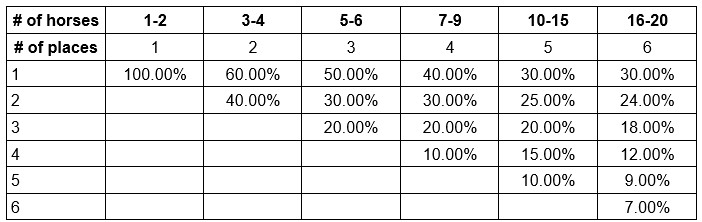
Prize money should be split by division (Open, Non-Pro, Non-Pro Rein/Box, Youth, Youth Rein/Box, Novice Horse, 3- & 4-Year-Old, Open Rein/Box) and based on show profit, jackpot fees and sponsorship collected for that show.
The NRCHA payout schedule should be used, which includes the following:
In the event of a tie, the competitor with the highest cow work will be declared the winner.
Additional prizes may also be given at any show, at the discretion of the Show Committee and/or the Board of Directors.
Any errors found in the show results will be corrected as soon as possible on the CCHA Facebook page. Members or show management must contact the CCHA Show Secretary within 30 days of the posting of these results for corrections to be made.
YEAR-END AWARDS
YEAR-END POINT TABULATION: A cumulative tabulation of all points earned by all entries during the show season shall be kept by the CCHA Show Secretary. Tabulation of points will be published on the CCHA Facebook.
TIES: If there is a tie in the points for year-end awards, the entry with the highest earnings shall be declared the winner.
HIGH POINT
All members in good standing who compete in 4 or more CCHA-approved shows will automatically be in the running for the year-end awards.
During the show season, points will be awarded in each division to horse and rider teams based on placings in approved CCHA show classes.
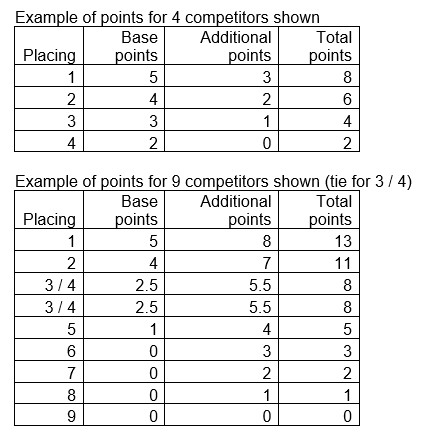
Base points will be awarded as follows:
1st place – 5 points
2nd place – 4 points
3rd place – 3 points
4th place – 2 points
5th place – 1 point
Additional points will be awarded equal to the number of other shown entries defeated in the class. See examples below. If only 1 entry is shown, they will receive 5 points total.
AVERAGE
In addition to the year-end high points winners, awards will be given in each division for the top average score for a horse and rider combination. This will be calculated by totalling the horse and rider’s scores in each class/division for the show season, then dividing by the number of shows entered in that class/division that year.